

Living Environment Studies
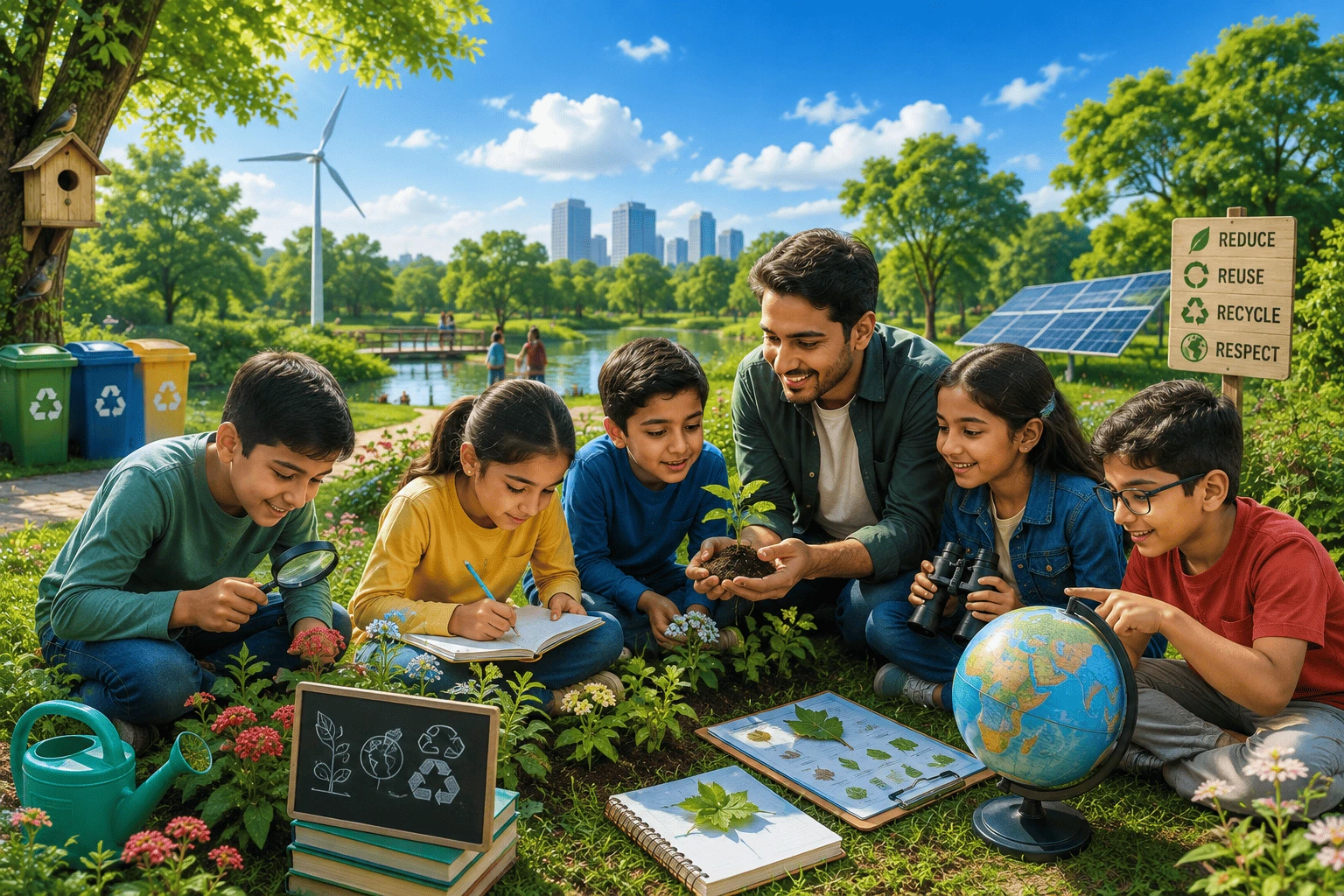
Living Environment Studies
- Core Philosophy & Overall Objectives—The primary goal is to nurture children’s ability to build a sound relationship with the surrounding and act independently as well as socially.
- Target Relationships: Focusing on building a relationship between the child and three entities: people around them, society, and nature.
- Methodology: Learning must happen through concrete activities and experiences, not abstract theory.
- Ultimate Goal: To help pupils acquire basic habits and essential life skills, contemplate their own lives, and develop a foundation for independence.
- Four Pillars of Learning Objectives (Grades 1-2)
The theory outlines four specific aims for children:
- Connection with the Society: To appreciate their locality and think about their social roles so that they can act in a safe and appropriate manner.
- Connection with the Nature: To become interested in animals and plants, appreciate nature’s beauty, and devise ways to play within it.
- Self-Confidence: To recognize their own strengths and potential through deep involvement with their surroundings, enabling them to live with willpower.
- Expression: To express what they have sensed and enjoyed during activities through language, drawing, behavior, and drama.
- Detailed Content Areas (The 9 Activity Domains)
The curriculum specifies nine distinct areas of study, which can be grouped into five themes:
- School & Safety
- School Life: Understanding school facilities and the people who support school life (teachers/friends) to enjoy studying safely.
- Commuting: Being interested in the safety of school routes and the people who ensure that safety.
- Family & Daily Habits
- Home Role: Thinking about the family that supports them and what they can do independently (chores/roles).
- Health: Learning to regulate their daily lives and look after their own health.
- Community & Public Morality
- Local Interaction: Feeling attachment to people living and working in the local community and maintaining proper relationships with them.
- Public Property: Understanding that public facilities (parks/libraries) are shared property supported by others, and learning to use them correctly and with care.
- Communication: Actively interacting with neighbors about local events and taking pleasure in these interactions.
- Nature & Play
- Seasonal Awareness: Sensing how life changes with the four seasons through observation and participating in seasonal events.
- Creative Play: Making toys/tools using natural objects to recognize their wonder and enjoying play with others.
- Biological Care: Raising animals and growing plants to understand that they are living/growing entities and learning to cherish them.
- Growth & Reflection
- Self-Reflection: Looking back on their own development to realize what they can now do on their own and acknowledging their increased roles.
- Gratitude: Feeling gratitude toward those who supported their growth.
- Implementation & Syllabus Guidelines
The document provides strict rules on how to teach this subject:
- Instructional Approach:
- Activities: Teachers must devise activities like “finding, comparing, and likening” to help pupils think based on recognition.
- Diversity: Opportunities must be given to interact with diverse groups, including the elderly, disabled, and young children.
- Integration: Teaching should coordinate with other subjects like Japanese language, music, and arts. In Grade 1, the curriculum should center around Living Environment Studies to combine subjects.
- Continuity & Scope:
- Long-term Projects: Raising animals and plants should be continuous over two years to deepen involvement.
- Moral Education: Instruction must align with the moral education objectives found in the “General Provisions”.
- Resource Utilization:
- Teachers should utilize local people, society, and nature in an integrated manner.
Activities/Games that imply Living Environment Science
- Bingo Card Games
- Open-Air Lunch
- The Interview Quest
Bingo Card Games
| Parallel Veins | A Parasitic Plant | Symmetry in Nature |
| Find a leaf where the lines run straight (like grass or banana leaf).
Sketch the pattern. | Find a plant growing ON another tree (fern or moss).
Why is it there? | Find a flower or leaf that looks exactly the same on both sides.
Sketch it. |
| The “Cactus” Adaptation | FREE SPACE | The Decomposer |
| Go to the Cactus House. Find a plant with no leaves.
Why does it have spines instead of leaves? | Macro-Photography:
Take a super close-up photo of tree bark texture. | Find a fungus, mushroom, or rotting log.
What is happening to the wood? |
| Aquatic Ecosystem | Seed Dispersal | Bamboo Joint (Gira) |
| Find a plant that floats on water.
How does it stay afloat? | Find a seed/fruit on the ground.
How did it get there? (Wind? Bird? Fell?) | Find a Bamboo tree. Count the segments between the ground and your eye level.
Write the number. |
A Table Explaining how this game incorporates Living Environment Science
| Bingo Task | Japanese Pedagogical Concept | Why it Develops Analytical/Lexical Skills |
| “Leaf Bigger than Your Hand” | (Comparison) | Children at this age struggle with abstract measurements (cm/inches). Using their own body (“Hand”) as a unit forces them to physically compare objects. This is the root of mathematical analysis. |
| “Find a Butterfly” | (Dynamic Vision) | In a green garden, finding a moving insect requires isolating a target from the background. This builds focus and attention to detail, critical for reading and data collection later. |
| “Rough to Touch” | (Sensory Input) | Vocabulary isn’t just words; it’s feelings. Touching bark vs. a petal grounds the abstract words “Rough” (Khoshkhoshe) and “Smooth” (Mosrin) in physical reality. This creates permanent lexical memory. |
| “Draw what you hear” | (Observation) | Drawing forces the brain to slow down. You cannot draw a sound; you must interpret the source (a bird, a car). This translates auditory signals into visual logic, a key analytical skill. |