

Project Proposal Road Safety and Drowning
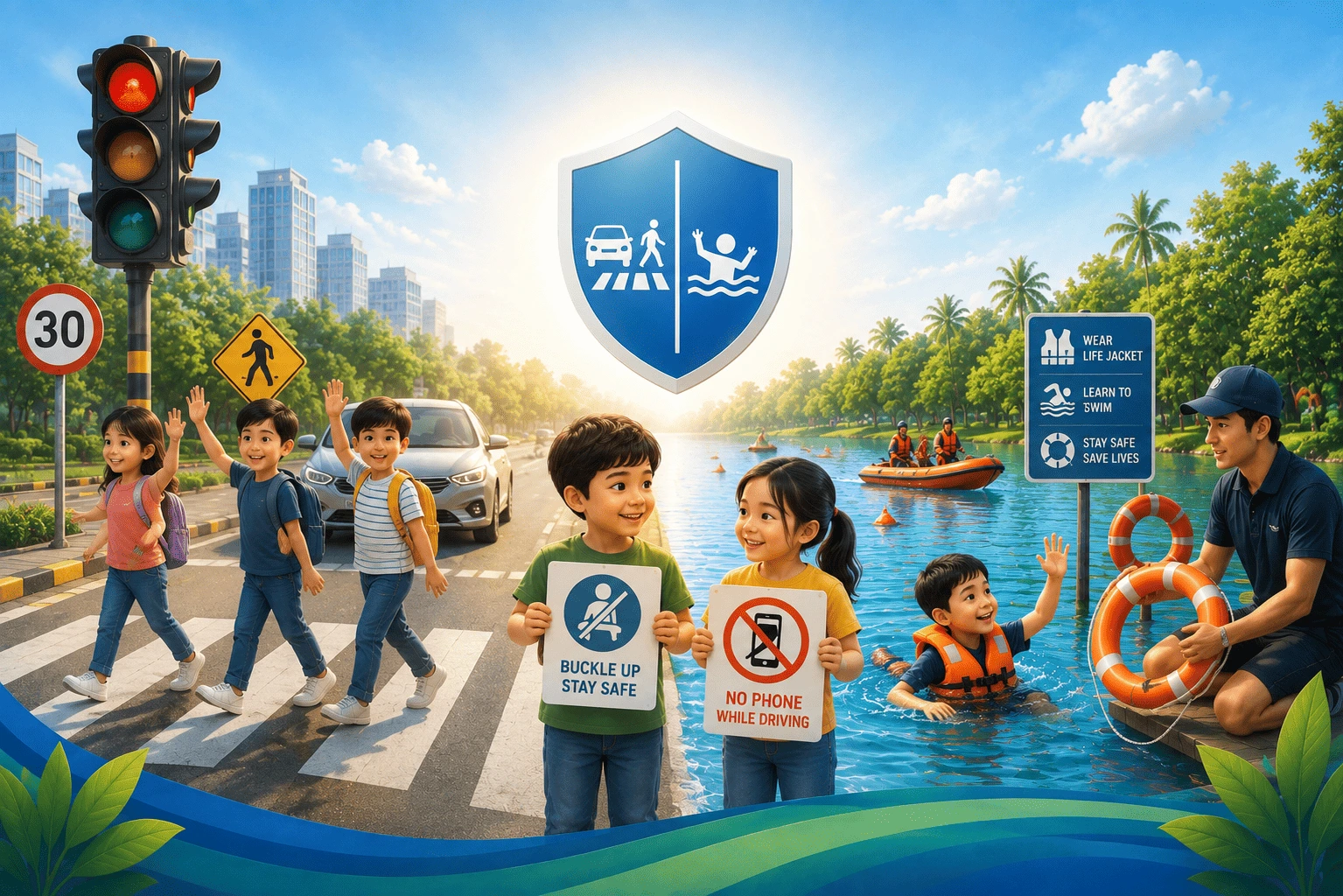
Project Proposal: Safe Steps, Safe Swims
A Community-Based Seminar & Workshop on Road Safety and Drowning Prevention
Target Audience: Children aged 6–12 and their Parents
Duration: 1 Day (6 Hour)
Location:
- Executive Summary
This project proposes a dual-focus intervention to address the two leading causes of unintentional injury death among children in Bangladesh: Drowning and Road Traffic Injuries (RTIs). Leveraging the proven “SwimSafe” and “Sisimpur” methodologies, this seminar will move beyond passive learning. It utilizes a “Learn-Do-Teach” model where children acquire survival skills and parents learn supervision strategies. The project is grounded in evidence showing that community-based education and skills training are highly cost-effective investments in child survival.
- Rationale & Problem Statement
The need for this intervention is critical and supported by recent epidemiological data:
The Drowning Crisis: Drowning is the leading cause of death for children in Bangladesh after infancy (ages 1–17). Data indicates a drowning mortality rate of 28.6 deaths per 100,000 child-years, which is 22 times higher than high-income countries.
Proximity to Danger: 80% of drowning incidents among young children occur within 20 meters of the family home.The
Road Safety Crisis: Road traffic injuries are a leading cause of death globally for children aged 10–19. In Bangladesh, children are uniquely vulnerable due to mixed traffic environments and a lack of designated safe crossings.
Vulnerability Factors: Children aged 6–12 are at high risk because their cognitive abilities (judging speed/distance) are not fully developed, and their small physical stature limits their visibility to drivers.
- Project Objectives
Increase Risk Awareness: To train 50 children and 50 parents to identify specific environmental hazards (e.g., open water bodies, blind spots on roads).
Teach Survival Skills: To equip children with Land-Based Rescue skills (Reach and Throw), which have been proven to have retention rates of 71%–87% even years after training.
Enhance Supervision: To educate parents on the necessity of active supervision, utilizing the “Anchal” model evidence which reduced drowning risk by 82% (Relative Risk 0.181).
- Workshop Methodology
The program uses the Child-to-Child and Adult-to-Adult mentorship model, which was successfully employed in the “Play Safe with Sisimpur” intervention to significantly improve injury prevention knowledge.
Part A: The Children’s Workshop (Ages 6–12)
Focus: Active participation and simulation.
| Module | Topic | Activity & Evidence Base |
| 1 | Road Safety: “Stop, Look, Listen” | Simulation: Children practice crossing a mock road.
Evidence: Addresses the “dart-out” behavior common in this age group due to impulsivity. |
| 2 | Water Safety: “Rescue without Entering” | Skills Drill: Children practice “Reach and Throw” rescues using bamboo poles or ropes from dry land.
Evidence: SwimSafe graduates showed 87.7% retention of reach rescue and 71.9% retention of throw rescue skills 10 years later. |
| 3 | Hazard Mapping | Art Activity: Children draw their walk to school and circle “danger spots” (ponds, busy intersections).
Evidence: Increases cognitive recognition of environmental risks. |
Part B: The Parents’ Seminar
Focus: Supervision and Community Strategy.
| Module | Topic | Content & Evidence Base |
| 1 | The Economics of Safety | Presentation on the cost-effectiveness of prevention.
Evidence: Interventions like SwimSafe cost only $13.46 per child, which is highly cost-effective compared to the economic loss of a child’s life. |
| 2 | Supervision Strategies | Discussion on the “Anchal” (daycare) concept. Parents learn that supervision is the most effective barrier against drowning for younger siblings.
Evidence: Community-based supervision centers reduced drowning deaths significantly in rural Bangladesh. |
| 3 | Environmental Barriers | Workshop on low-cost home barriers (door gates, pond fencing).
Evidence: 26% of deaths in children 1–4 are due to drowning, often because of easy access to water. |
- Expected Outcomes & Impact Strategy
Based on the provided documents, this project aims to replicate the following success metrics:
- Protective Rate: The “SwimSafe” program was found to be 96% protective against drowning. We aim to initiate this protective effect by teaching the pre-requisite land-based rescue skills.
- Knowledge Retention: By using the “Sisimpur” mentorship model, we expect a significant increase in knowledge retention regarding road signs and water hazards, as observed between baseline and end-line surveys in the Sisimpur evaluation.
- Cost-Effectiveness: The project aligns with WHO-CHOICE guidelines, which classify these interventions as “very cost-effective,” with a cost per DALY (Disability-Adjusted Life Year) averted of only $85 for SwimSafe interventions.
- Conclusion
Implementing this seminar is not merely an educational exercise; it is an adoption of proven life-saving interventions. As the UNICEF World Report states, implementing proven interventions could save more than a thousand children’s lives a day. This project provides the first step in that direction for our community.