

Project Proposal
Project Title: Bridging the Divide: AI-Integrated Learning for Secondary Education in Rural Bangladesh
- Executive Summary
We are launching this pilot initiative to tackle the digital divide in rural Bangladesh. By bringing Artificial Intelligence (AI) directly into the secondary school curriculum, we aim to level the playing field for students who have been left behind. Working alongside Exambinary, our “Teacher-First” approach goes beyond simply installing hardware; we are building an ecosystem where infrastructure meets inspiration. Our goal is to transform 50 students from passive learners into “future-ready” youth, while giving teachers and students the generative AI they need to succeed.
- Rationale:
Despite high enrollment numbers, the quality of education in Bangladesh is facing a crisis. The UNICEF (2025) paints a worrying picture: after five years of primary school, only half of our children can read properly in Bangla, and fewer than one-third have grasped basic math. This challenge is even harder for rural communities. While urban schools are rapidly adopting new tech, village students are being left further behind, widening an already dangerous inequality gap. If we don’t act, these students won’t just be behind in class—they will be locked out of the modern economy. Consequently, we try to integrate AI within the learning ecosystem, which is advised by the UNICEF.
Our Solution We believe AI can be the great equalizer. As UNICEF suggests, bridging this digital divide is key to fixing the gaps in our educational resources. Therefore, we are deploying AI solutions that are culturally and linguistically adapted to work for our students in our context.
- Evidence-Based Strategy
We are following proven strategies backed by recent research (2024–2025):
- Sparking Innovation: We know that simply giving students digital device or tools isn’t enough. However, recent findings by (Wu & Zhang, 2025) show that when students actively use Generative AI, it significantly boosts their innovation skills and digital literacy. We want our students to actively participate in the learning process.
- Keeping Students Engaged: In a crowded rural classroom, it’s easy for a student to feel invisible. Zhan et al. (2025) found that AI tools can bridge this gap by offering personalized, immediate feedback—keeping students emotionally and cognitively engaged even when the teacher is busy with others.
- Supporting Our Teachers: We know teachers are overworked. A 2024 review by (Lee & Moore, 2024) confirms that automated AI feedback systems can take the heavy lifting out of grading. This frees up our teachers to actively allocate more time in the teaching process.
- Objectives
- Seamless Integration: Make AI a normal, helpful part of the daily routine for Class 6–10, not just a special occasion.
- Teacher Empowerment: Give our educators the confidence to use AI for lesson planning, directly addressing the skills gap highlighted by UNICEF.
- Future Skills: Specifically target Class 9–10 students with the skills to innovate and problem-solve, applying the proven methods from Wu & Zhang
- Local Relevance: Ensure every tool adapts the language and culture of Bangladesh.
- Implementation Plan:
The Implementation Plan is given below
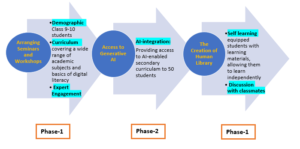
Phase 1:
Before we start teaching, we will ensure the foundation is solid. This means securing reliable internet, modern devices, and stable power backup. Crucially, we will work with Exambinary to customize the interfaces linguistically and culturally so that language is never a barrier.
Phase 2:
We are starting with the teachers. Through our “AI for Teachers” workshops, we will turn skepticism into confidence. As Lee & Moore, (2024) pointed out, AI is a powerful ally for managing workload, and we want our teachers to feel that benefit immediately.
Phase 3:
For our Class 9–10 students, we are limiting batch sizes to ensure quality. These hands-on workshops will use GenAI to let students build and create. This aligns perfectly with (Wu & Zhang, 2025)findings: when students use these tools to create, they transform from passive listeners into active innovators.
Reference List
Lee, S. S., & Moore, R. L. (2024). Harnessing Generative AI (GenAI) for Automated Feedback in Higher Education: A Systematic Review. Online Learning Journal, 28(3), 82–104. https://doi.org/10.24059/olj.v28i3.4593
UNICEF. (2025). Child Rights Manifesto: A Promise to Every Child in Bangladesh.
Wu, D., & Zhang, J. (2025). Generative artificial intelligence in secondary education: Applications and effects on students’ innovation skills and digital literacy. PLoS ONE, 20(5 May). https://doi.org/10.1371/journal.pone.0323349
Zhan, Y., Boud, D., Dawson, P., & Yan, Z. (2025). Generative artificial intelligence as an enabler of student feedback engagement: a framework. Higher Education Research and Development, 44(5), 1289–1304. https://doi.org/10.1080/07294360.2025.2476513